More Than Human: An Immersive AI Experience in Miami
Exploring Miami’s Frost Science and AI evolution at “AI: More than Human”
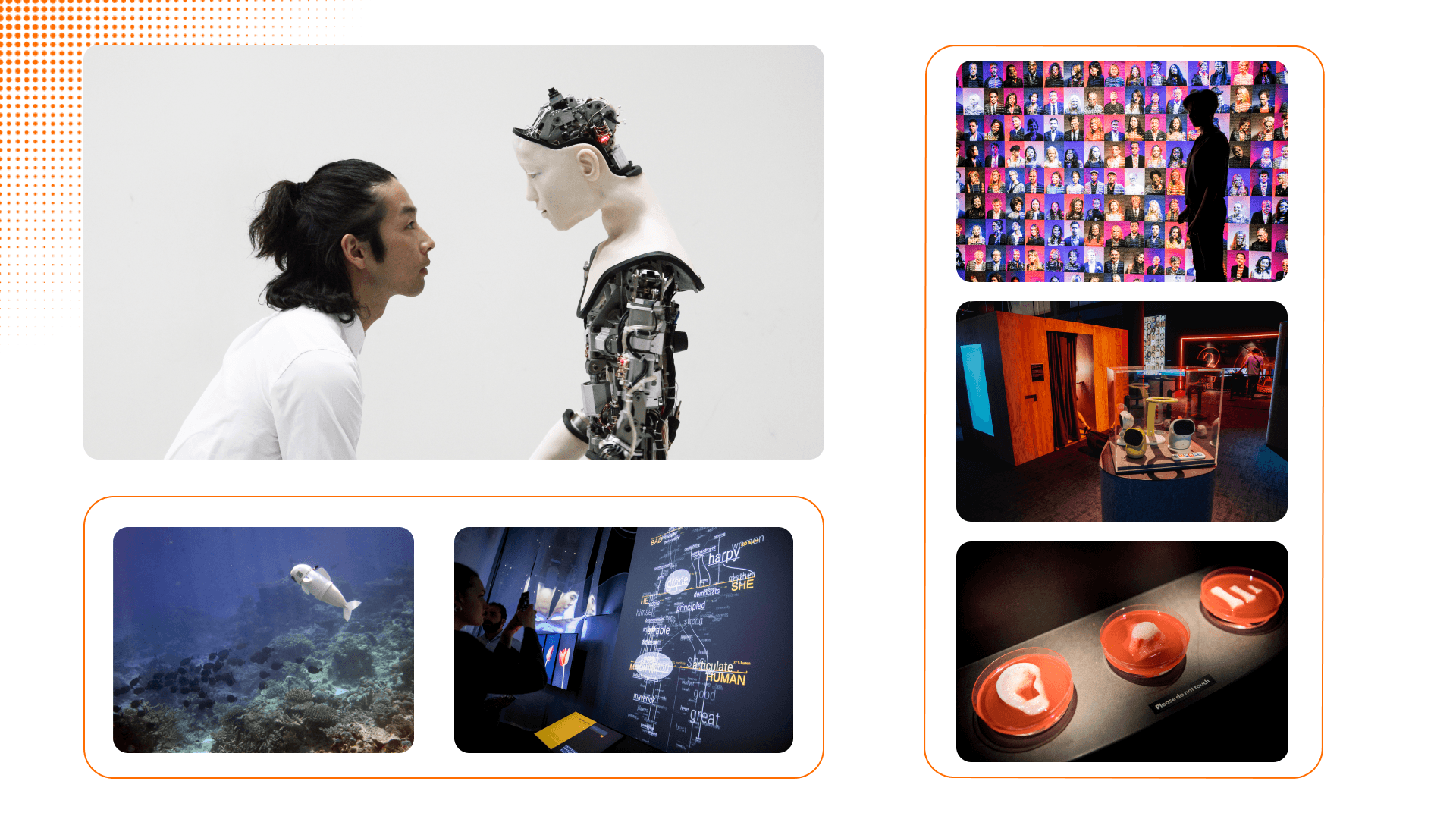
Curiosity, observation, countless snapshots, connections, and insights marked my trip to the Frost Science Museum, one of the world’s leading museums dedicated to science and innovation, located in Miami, United States. I visited the exhibition “AI: More than Human,” where immersive installations take us on a journey through time and space, exploring the evolution of the relationship between humans and technology.
I’ll try to describe some of the experiences I had there, but nothing compares to the feeling of interacting with machines and cutting-edge research projects that few people have had access to so far.
Starting from the origins of AI, the exhibition travels through Japan, where the first breakthroughs paved the way for the virtual reality we experience today.
Among the many experiences that stood out to me, a few particularly highlighted how artificial intelligence and biotechnology are crossing boundaries that once seemed impossible. One impressive example is the Organs-on-Chips technology, developed by the Wyss Institute in partnership with Emulate. Using a transparent, flexible silicone polymer (created in 2008), this innovation simulates the function of human organs on microchips. This allows scientists to test drugs or study diseases with far greater precision, without the need for animal or human testing.
Another remarkable highlight was the work of the Wake Forest Institute for Regenerative Medicine, based in North Carolina, which is using 3D bioprinting to create human tissues such as ears, noses, and bones using the patient’s own cells as the “ink” for implants. This sparks a creative question for those of us working with innovation: if it’s already possible to print body parts, what else can we build by combining data, precision, and purpose?
The section on A-Life—a research field dedicated to studying artificial life in systems that are not biologically alive but behave as if they were—showcases models that simulate ecosystems, genetic evolution, and even the collective behavior of organisms, demonstrating how AI can learn and create autonomously.
There were also earlier generations of humanoid robots, such as NAO version 3.3 (2008–2010) and Yuwain (2009–2018), as well as Sony’s iconic robotic dog, Aibo (1999), illustrating how emotional robotics has become increasingly advanced. These robots were designed to interact empathetically with humans, recognizing voices, gestures, and even emotional states—bringing AI into social, educational, and domestic environments.
I even saw a robotic shark so realistic that it made me reflect on how technology can become invisible—or rather, seamlessly integrated into the natural world.
The exhibition, curated by the Barbican Centre in London, is based on research showing how Artificial Intelligence is already embedded in multiple aspects of our lives. It’s a blend of science and art that left me inspired and brimming with ideas to apply in our daily work. Among the artists, scientists, and researchers featured in the exhibition are Joy Buolamwini, Mario Klingemann, Kode9, Lawrence Lek, Massive Attack, Lauren McCarthy, Neri Oxman, Chris Salter, Xenoangel, and Universal Everything.
Another key highlight of this trip was the conversations and connections I made with people who, like us, are already applying innovation in their everyday work. I brought back many insights to share with the Wigoo team, and through collaborative brainstorming, we’re turning them into real solutions for our clients.
By Gustavo Santana, Co-CEO at Wigoo.
Link: https://marcaspelomundo.com.br/opiniao/mais-que-humano-uma-experiencia-imersiva-com-ia-em-miami/